For Brisbane businesses, a full order book can still coincide with a tight bank balance. Labor, stock, freight, rent, and regular bills often need to be paid before customers settle their invoices. Used carefully, invoice financing for Brisbane businesses may be one option for bridging a timing gap, but the strongest starting point is a clear system for forecasting, invoicing, and following up on payments. Whether you operate from the CBD, the northside, Logan, Ipswich, or the bayside, cash flow deserves attention before it becomes urgent. Brisbane’s service providers, construction contractors, wholesalers, and trade businesses can all face the same challenge: money has been earned, but it has not arrived in the account when payroll or supplier bills fall due.
Table of Contents
- 1 Why a Profitable Business Can Still Run Short of Cash
- 2 Early Warning Signs of a Cash Flow Gap
- 3 Build a Simple Rolling Cash Flow Forecast
- 4 Improve Invoices and Set Clear Payment Terms
- 5 Use a Calm, Consistent Late-Payment Process
- 6 Manage Suppliers, Bills, and a Cash Buffer
- 7 When Short-Term Funding May Help
- 8 Common Cash Flow Mistakes to Avoid
- 9 A Seven-Day Cash Flow Action Plan
- 10 Conclusion
Why a Profitable Business Can Still Run Short of Cash
Profit is the difference between revenue and costs over a period. Cash is the money available to meet obligations today. A business may invoice $30,000 for completed work in June, record a profit on that work, and still be short of cash if the customer pays in August, while wages, materials, and subcontractors must be paid in July. Fast growth can sharpen this pressure. Winning larger jobs may require additional staff, equipment, materials, or inventory before related payments are received. Smaller businesses may feel the effect sooner because they have less spare cash available to absorb a delayed invoice or an unexpected cost.
Early Warning Signs of a Cash Flow Gap
Cash flow pressure is easier to manage when it is visible early. Review these signs each week:
- Invoices are often paid after their due dates.
- One or two customer accounts account for most expected receipts.
- Personal funds are regularly used for business bills.
- Supplier payments are being delayed without an agreed plan.
- Payroll, tax, superannuation, or loan dates are approaching without funds set aside.
- Stock is being purchased before demand is reasonably confirmed.
- Sales look healthy, but the bank balance remains low.
Build a Simple Rolling Cash Flow Forecast
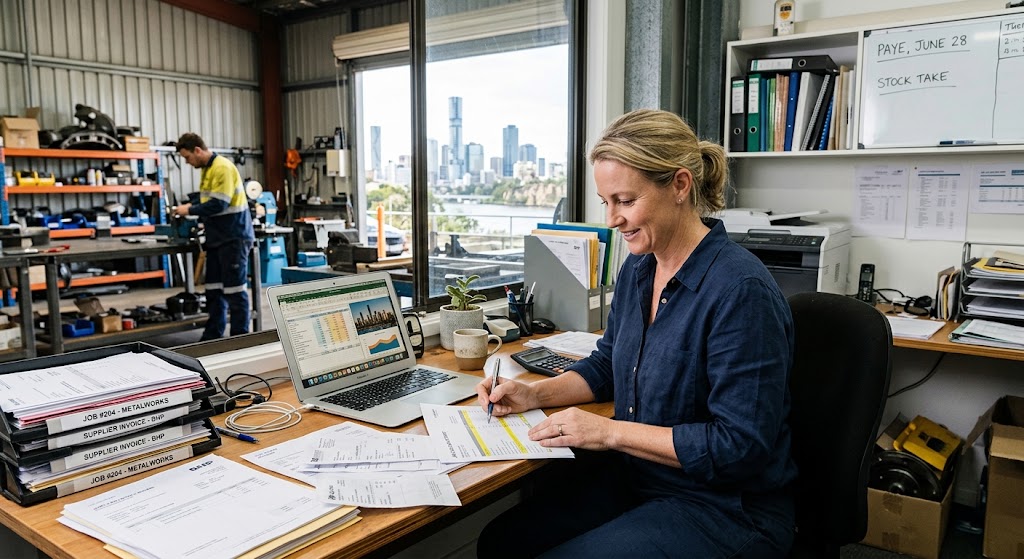
A rolling eight to 13-week forecast gives a Brisbane business owner a practical view of the weeks ahead. The Australian Government’s guidance on preparing a cash flow statement explains that tracking cash inflows and outflows can help identify future shortages and plan upcoming payments. Photorealistic wide establishing shot of a Brisbane small-business owner reviewing cash flow figures at a desk in a busy workshop or office, with invoices, a laptop, and business activity visible in the broader setting, natural daylight, and the Brisbane city skyline subtly visible through the windows.
- Start with the opening bank balance for each week.
- List expected customer receipts using likely payment dates, not just invoice dates.
- Add fixed costs, including wages, rent, software, insurance, and loan repayments.
- Include variable costs such as materials, fuel, freight, and subcontractors.
- Place BAS, tax, superannuation, license renewals, and annual bills in the week they are due.
- Calculate the expected closing balance and flag weeks that fall below a chosen safety level.
- Update the forecast weekly by comparing expected figures with actual cash movements.
Test More Than One Scenario
Use a cautious version of the forecast as well as an expected version. For example, test the effect of a major customer paying 14 or 30 days late. This simple exercise can reveal whether the business needs to adjust spending, contact customers earlier, or arrange support before a shortfall occurs.
Improve Invoices and Set Clear Payment Terms
Invoice promptly once work is complete or a milestone is met. Check the customer’s legal entity name, purchase order number, job reference, bank details, and contact person before sending it. Clear descriptions of delivered work or goods can make internal approval easier for the customer. Agree to payment terms before work begins, then repeat them on quotes, contracts, and invoices. A Brisbane contractor that pays for materials upfront may need a deposit and staged progress claims. A consultant may use a monthly retainer or invoice at agreed project milestones. The goal is to align better the timing of incoming payments with the timing of outgoing costs.
- Offer suitable electronic payment methods.
- Set reminder notices before and shortly after the due date.
- Keep disputed invoices separate from unpaid invoices.
- Review delivery-to-invoice and invoice-to-payment timeframes for recurring customers.
- Consider revised terms or a deposit for customers with a pattern of late payment.
Use a Calm, Consistent Late-Payment Process
Following up should be routine rather than confrontational. Send a friendly reminder before the due date, then contact the customer soon after an invoice becomes overdue. Ask directly whether there is a missing document, an approval delay, or a genuine dispute. If a payment date is promised, confirm it in writing and record the next action. For older debts, escalate the matter to the appropriate accounts payable contact or decision-maker. Keep communications factual and professional. If payment behavior does not improve, reassess whether new work should proceed on a deposit, with shorter payment terms, or with another arrangement that reduces exposure.
Manage Suppliers, Bills, and a Cash Buffer
Speak with important suppliers before a payment is missed. Where appropriate, ask whether payment dates can better align with customer receipts or whether an order can be split into smaller deliveries. Compare any early-payment discount with the value of retaining cash for essential obligations. Build a buffer gradually. Begin with a target that covers one major expense cycle, then allocate a set portion of customer receipts when cash permits. Keep funds for tax and employee-related obligations separate from everyday operating money. Review the target whenever staffing, overheads, sales volume, or customer concentration changes.
When Short-Term Funding May Help
Funding can be useful when it solves a defined timing issue, not when it hides ongoing losses or pricing problems. Depending on the business and its circumstances, options may include invoice-based funding, a line of credit, equipment finance, trade finance, or a business loan for a specific project. Before proceeding, compare the total cost, fees, repayment timing, security requirements, and effect on future cash flow. Businesses supplying larger organizations can also consult the Australian Government’s payment times reporting scheme for information intended to improve transparency around the payment practices of certain large businesses and government enterprises.
Common Cash Flow Mistakes to Avoid
- Assuming sales growth automatically creates available cash.
- Waiting too long to follow up on overdue invoices.
- Accepting lengthy terms without considering their cost to the business.
- Using short-term finance to cover a permanent operating shortfall.
- Overlooking tax, payroll, and superannuation dates.
- Purchasing equipment or stock without first updating the forecast.
A Seven-Day Cash Flow Action Plan
- Day one: List every unpaid invoice and its expected payment date.
- Day two: Contact overdue customers and document each next step.
- Day three: Prepare an eight-week cash flow forecast.
- Day four: Review upcoming payroll, tax, supplier, and loan obligations.
- Day five: Identify spending that can be reduced, delayed, or renegotiated.
- Day six: Review deposits, milestones, and terms for new work.
- Day seven: Schedule a fixed weekly review of receivables and cash flow.
Conclusion
Waiting to be paid does not have to leave a Brisbane business unprepared. A current cash-flow forecast, accurate invoices, clear payment terms, early follow-up, and careful supplier planning can help reduce the strain created by payment delays. Businesses can also review upcoming payroll, tax obligations, rent, stock purchases, loan repayments, and other essential expenses to gain a clearer view of when cash will be needed. Where possible, setting aside a working-capital buffer can provide additional flexibility when customer payments arrive later than expected. When a funding option is considered, it should support a realistic plan based on expected cash receipts, repayment costs, and essential business obligations rather than simply covering an ongoing shortfall. Reviewing these factors regularly can help Brisbane business owners respond more quickly, maintain day-to-day operations, and make more informed decisions when payment timing does not align with outgoing expenses.