
Flat roofing systems often age quietly, showing subtle changes long before leaks ever appear. Many property owners only notice a problem once water enters the building, even though warning signs were present months earlier. For anyone responsible for a building in Huntsville AL, understanding early membrane shrinkage can prevent costly repairs and help commercial roof contractors in Huntsville AL address problems before they escalate.
Table of Contents
- 1 Understanding What Causes Flat Roof Membrane to Shrink
- 2 Early Wrinkles and Ripples That Signal Shrinkage Issues
- 3 Why Cracks near Seams Indicate Material Stress
- 4 The Role of Temperature Cycles in Accelerating Shrinkage
- 5 What Happens When Ponding Water Shows up on a Shrinking Roof
- 6 How Uneven Surface Tension Points to Membrane Contraction
- 7 Why Loose Flashing Can Reveal Underlying Shrinkage Problems
- 8
- 9 Signs Around Roof Penetrations That Hint at Material Pull-back
Understanding What Causes Flat Roof Membrane to Shrink
Membrane shrinkage usually begins at the material level. Over time, roofing membranes lose plasticizers and flexibility due to exposure to heat, UV radiation, and chemical reactions within the material itself. As the membrane dries out, it slowly contracts, pulling against seams, edges, and attachment points.
Environmental conditions play a major role as well. Prolonged sun exposure, high surface temperatures, and repeated thermal expansion and contraction accelerate the process. Huntsville commercial roof contractors often see shrinkage develop faster on buildings with minimal shade or inadequate insulation beneath the membrane.
Early Wrinkles and Ripples That Signal Shrinkage Issues
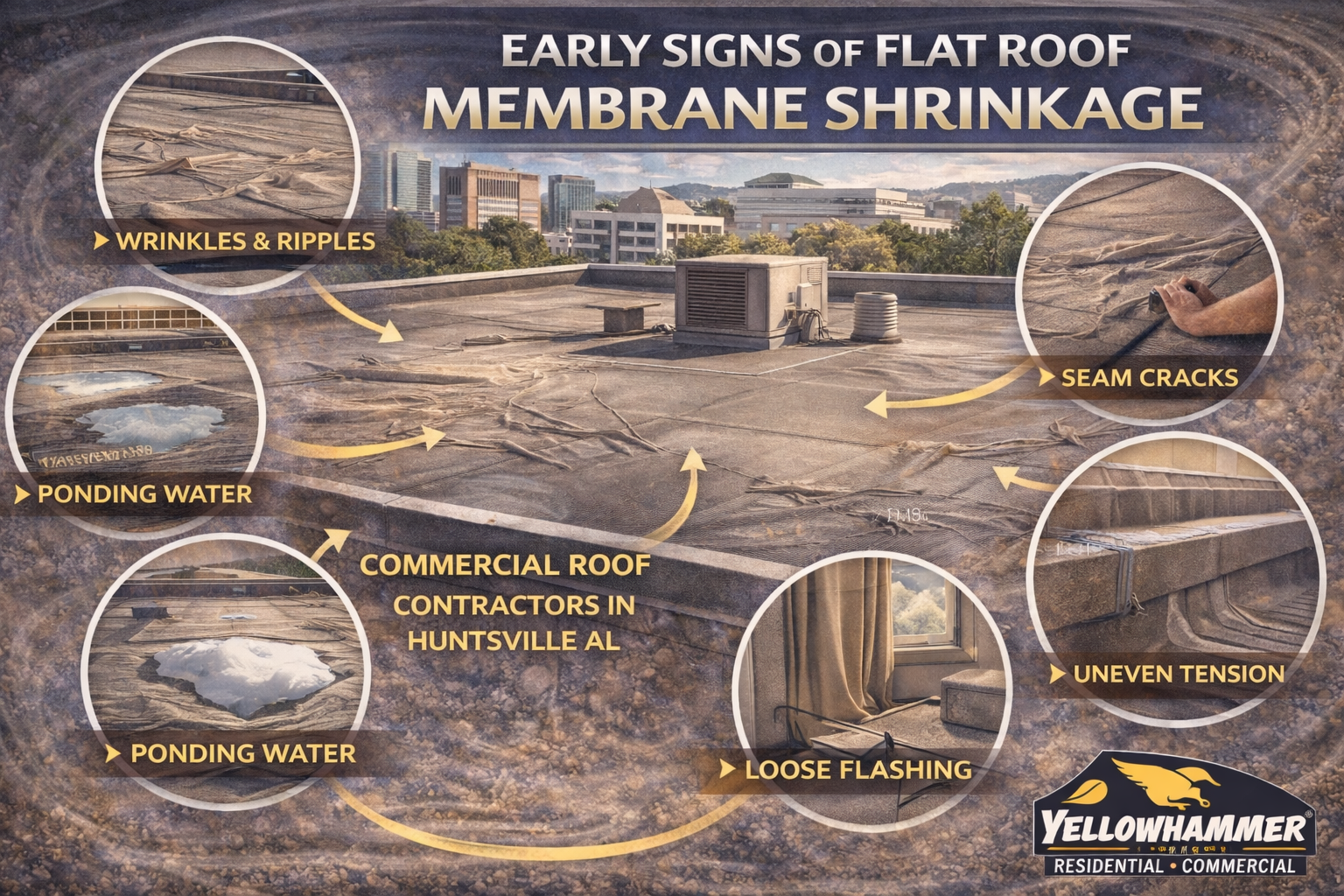
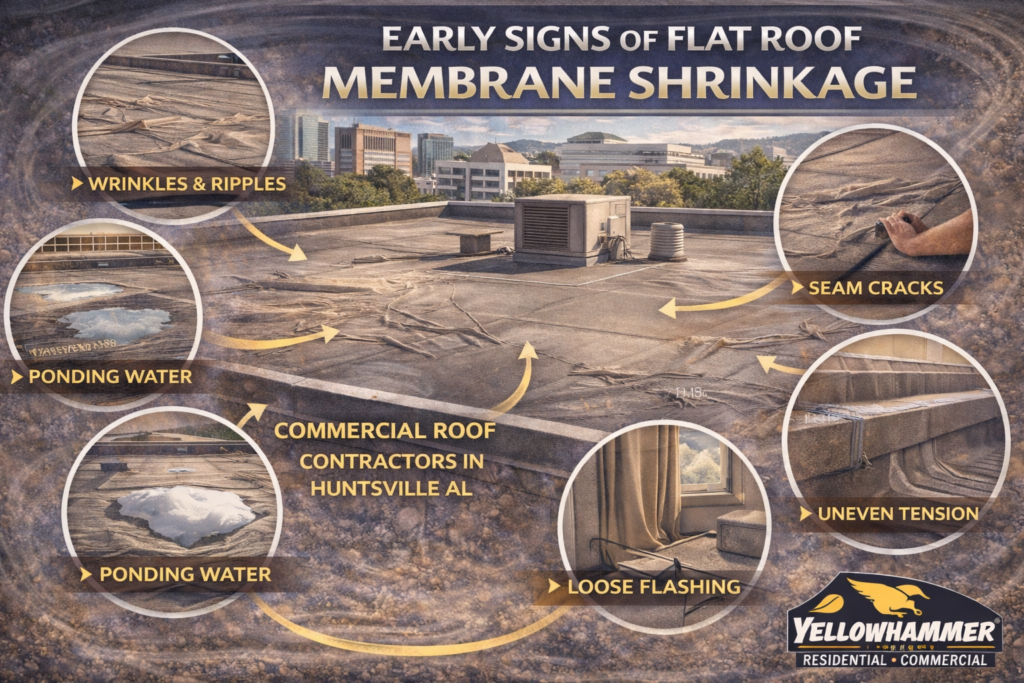
Wrinkles and ripples are often the first visible clues that a membrane is under stress. These surface distortions appear when the material begins pulling inward but is still partially adhered or fastened in place. Instead of lying flat, the membrane gathers or buckles slightly.
These irregularities are easy to dismiss during casual inspections. However, experienced roof contractors recognize that surface distortion usually precedes seam failure. Roof companies near me often identify these early ripples as a signal to inspect attachment points and perimeter details more closely.
Why Cracks near Seams Indicate Material Stress
Seams endure more tension than most areas of a flat roof. When shrinkage occurs, stress concentrates along welded or adhered seams, leading to hairline cracking or splitting. These cracks may start small, appearing only during temperature swings.
Over time, repeated stress widens these cracks and compromises waterproofing. Commercial roofing contractors know that seam cracking is rarely an isolated issue; it often reflects broader membrane contraction happening across the entire surface.
The Role of Temperature Cycles in Accelerating Shrinkage
Daily temperature swings cause roofing membranes to expand and contract repeatedly. In Huntsville AL, warm days followed by cooler nights create constant movement within the material. Each cycle weakens the membrane’s elasticity slightly more.
Seasonal extremes amplify this effect. As the membrane loses flexibility, it cannot recover fully after each cycle, leading to gradual but permanent contraction. Roofing near me inspections frequently reveal shrinkage damage that aligns with prolonged periods of thermal stress.
What Happens When Ponding Water Shows up on a Shrinking Roof
Ponding water is often treated as a drainage issue, but it can also indicate membrane shrinkage. As the membrane pulls tight, it may alter the surface slope, creating low spots where water collects. These areas place additional weight and stress on an already strained system.
Standing water accelerates material breakdown by increasing heat absorption and chemical exposure. Roof contractors often view ponding combined with other shrinkage signs as a red flag that the membrane’s structural balance has been compromised.
How Uneven Surface Tension Points to Membrane Contraction
Shrinkage does not occur uniformly. Certain areas of the roof may experience greater exposure or weaker adhesion, causing uneven tension across the surface. This imbalance creates zones where the membrane feels overly tight in some spots and loose in others.
Uneven tension leads to unpredictable failures. Huntsville commercial roof contractors often test surface tension by examining how the membrane responds to light pressure. Areas that feel rigid or overstretched often indicate active contraction beneath the surface.
Why Loose Flashing Can Reveal Underlying Shrinkage Problems
Flashing is designed to remain securely bonded while accommodating movement. When a membrane shrinks, flashing becomes a stress point where pull-back is most noticeable. Loose or lifted flashing around edges and transitions often signals that the membrane is contracting away from its original position.
These conditions create vulnerable entry points for water. Roof companies near me routinely trace flashing failures back to membrane shrinkage rather than installation error, especially on older flat roofing systems.
Signs Around Roof Penetrations That Hint at Material Pull-back
Roof penetrations such as vents, pipes, and curbs restrict membrane movement. As shrinkage progresses, the membrane pulls away from these fixed elements, creating gaps or tension cracks around penetration bases.
These areas are particularly sensitive because even small separations can allow moisture intrusion. Commercial roofing contractor inspections often focus on penetrations when shrinkage is suspected, as they reveal early pull-back patterns before widespread failure occurs.
Early detection makes a measurable difference in flat roof performance and longevity. Yellowhammer Roofing helps property owners identify shrinkage issues through detailed inspections, practical repair strategies, and long-term system planning. Their approach supports early intervention, minimizing disruption and protecting buildings from avoidable damage caused by membrane contraction.