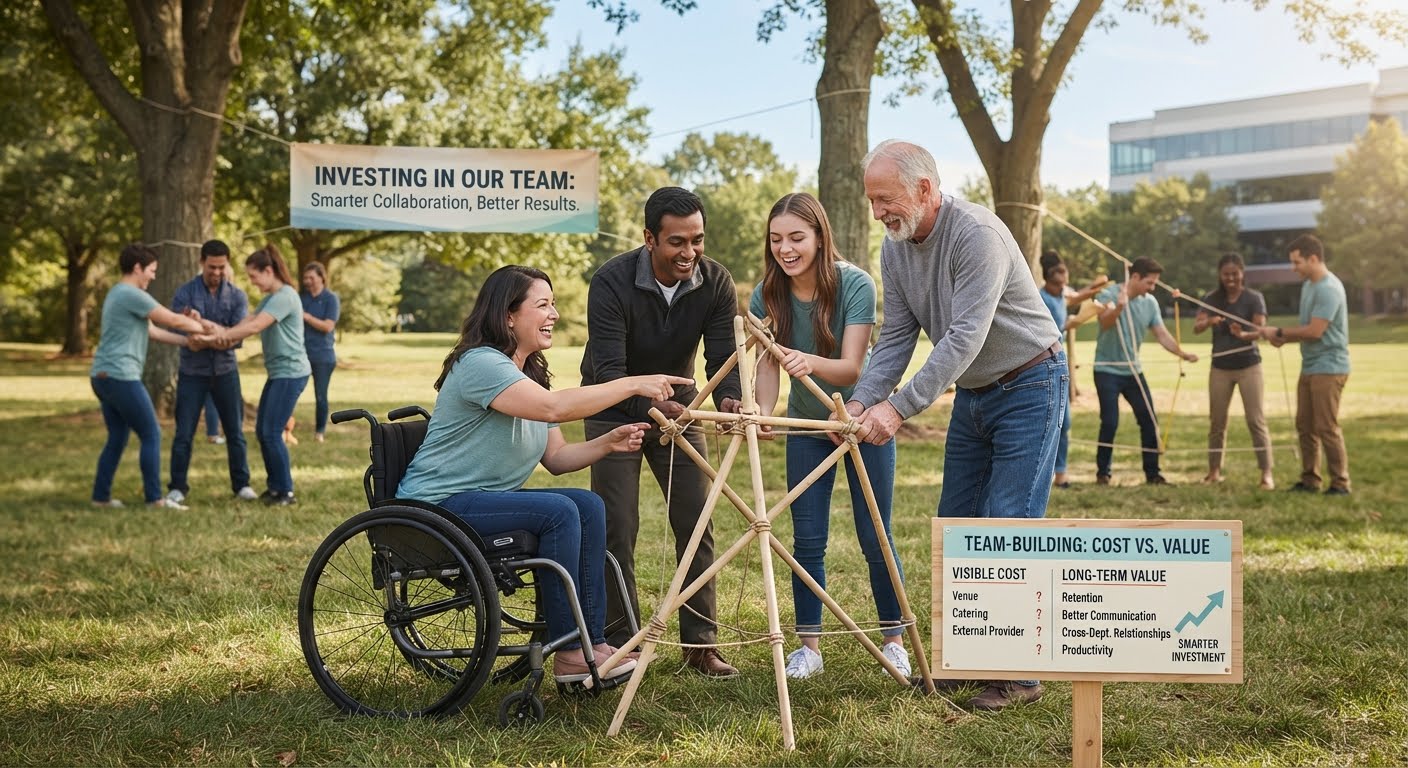
Team-building is often treated as a nice extra: something businesses organise when budgets are comfortable, morale needs a lift or the annual calendar calls for an away day. Looked at purely from a cost perspective, it can therefore seem difficult to justify. There is a venue, time away from normal work and often an external provider to pay for.
The problem with that view is that it considers only the visible cost of the event and ignores the less obvious cost of poor team dynamics. Miscommunication, weak relationships, low engagement and departmental friction can all affect productivity, retention and decision-making. When those issues are taken into account, well-designed team-building starts to look less like an expense and more like an investment in how effectively people work together.
The Financial Cost of Poor Collaboration
Businesses rarely receive an invoice labelled “poor communication”, yet the cost can still be significant. Delayed decisions, duplicated work, avoidable mistakes and missed information all absorb time that could have been used more productively.
The same applies when teams operate in silos. One department may spend hours solving a problem that another team has already encountered. Employees may avoid asking for help because they do not know colleagues elsewhere in the business well enough to approach them comfortably. Managers can end up mediating misunderstandings that stronger working relationships might have prevented.
None of these problems will necessarily appear as a neat line on a financial statement, but they still affect efficiency. The larger and more complex a business becomes, the more expensive small communication failures can become.
Where Team-Building Creates Value
The strongest business case for team-building comes when the activity has a purpose beyond entertainment. A well-planned event can give employees the chance to communicate with people they do not usually work with, understand different personalities and practise collaboration in a low-risk environment.
Providers such as The Big Smoke Events create structured team experiences where colleagues have shared challenges to complete rather than simply being placed together and expected to socialise. That distinction matters. A common objective gives people a reason to interact naturally, and employees can build familiarity while concentrating on the task in front of them.
The commercial benefit is unlikely to come from the event itself. It comes afterwards, when employees return to work with better relationships, greater confidence in one another and a clearer sense of how colleagues communicate.
Four Areas Where the Return Can Appear
The return on team-building is not always straightforward to calculate, but there are several areas where businesses may see practical benefits.
- Communication can become easier. Employees who have spent time together informally may feel more comfortable asking questions, raising concerns or contacting another department for help.
- New employees can integrate more quickly. A shared activity can help new starters meet a wider group of colleagues in a short period of time, reducing the awkwardness that sometimes comes with joining an established team.
- Cross-department relationships can improve. Employees who previously knew each other only through emails or requests may gain a better understanding of how other teams work.
- Morale can improve when people feel connected. Work becomes easier when colleagues trust one another and feel part of something larger than their immediate role.
None of these outcomes guarantees an immediate financial return, but all can influence how smoothly the organisation operates.
Retention Changes the Calculation
Employee turnover is expensive. Recruitment takes time, vacancies place pressure on existing staff, and new employees need a period of training before they reach full productivity. Businesses therefore have a financial incentive to create an environment where good employees want to stay.
Team-building alone will not retain someone who is underpaid, badly managed or unhappy with their role. However, workplace relationships are one part of the overall employee experience. People are generally more likely to feel connected to an organisation when they have positive relationships with colleagues and a sense of belonging.
This is especially relevant in hybrid and distributed workplaces, where employees may have fewer informal opportunities to get to know one another. Deliberate shared experiences can help replace some of the social contact that once happened naturally in offices.
From a financial perspective, even a small improvement in retention can matter if it helps avoid the cost of replacing experienced employees.
Productivity Is Not Only About Working Faster
Productivity is often discussed in terms of systems, automation and individual output, but team performance also depends heavily on relationships.
A group of highly capable employees can still perform poorly if they do not trust one another, communicate badly or struggle to coordinate their work. By contrast, a team with strong internal relationships may solve problems more quickly because people know who to involve and are comfortable sharing information.
Team-building can support this by revealing how people work outside their usual roles. Someone may prove excellent at organising a group, another may be strong at spotting detail, while someone else may be particularly good at keeping others calm under pressure.
These insights can carry back into the workplace and influence how teams approach real projects.
The Wrong Event Can Be a Poor Investment
None of this means every team-building activity represents good value.
An event that employees dislike, find embarrassing or consider irrelevant can easily become counterproductive. If people feel they have been forced into something unsuitable, the business may spend money without gaining any meaningful benefit.
The choice of activity therefore matters. It should suit the personalities, physical abilities and interests within the workforce. Competitive activities may work well for some groups but not others, while quieter teams may prefer collaborative challenges where success depends on problem-solving rather than performance.
The purpose also needs to be clear. If the objective is to improve communication between departments, teams should be mixed accordingly. If the priority is helping new starters integrate, the event should encourage interaction with established employees.
Good planning improves the chances that the investment produces something useful rather than simply filling an afternoon.
Think Beyond the Cost Per Person
When evaluating team-building, businesses can easily focus on the immediate cost per employee. That figure is useful, but it tells only part of the story.
The more relevant question is what the business hopes to improve. If stronger relationships help a project move faster, reduce staff turnover, improve communication or make a newly formed team more effective, the value may significantly exceed the original event cost.
There is also a difference between spending and investing. Spending ends when the event finishes. Investment is intended to create a longer-term benefit.
Team-building becomes an investment when it is connected to a genuine organisational need and followed by an environment that allows stronger relationships to continue developing.
The event itself should therefore be viewed as one part of a wider approach to employee engagement, communication and culture.
Businesses will always need to scrutinise discretionary costs, particularly when budgets are under pressure. Team-building should not be exempt from that scrutiny. However, dismissing it simply because the return is harder to measure than a piece of equipment or software can overlook the financial importance of how well people work together.
Stronger teams can communicate faster, cooperate more easily and create a better employee experience. When an event is chosen carefully and linked to a clear business objective, that can make team-building a far smarter investment than its reputation sometimes suggests.